Every fall, a large share of our calls come from people who have never owned a sprinkler system in Central Texas. Some just closed on a new build in Leander, Hutto, or Pflugerville. Some bought an older home in Austin that came with a system nobody explained to them. Many moved here from Colorado, Illinois, or another cold-weather state, where "winterizing" means something very different.
If that sounds like you, this guide is for you. It covers what to learn about your system before the first cold front, what new-construction systems commonly get wrong, how to set a winter schedule, and what to do when a hard freeze is in the forecast. It is written for the homeowner who wants to understand their system, not just hand it off.
The Quick Answers to Sprinkler Winterization
- Do not use a northern-style sprinkler blowout. Most Central Texas systems do not require their underground lines to be drained, although some exposed components may need additional freeze protection.
- Do not turn the system off for the winter. Reduce the run times instead. The exception is when a freeze is predicted.
- Find your irrigation shut-off valve and your backflow preventer before it gets cold.
- Insulate the backflow preventer if it sits above ground.
- Set a winter watering schedule and confirm your rain/freeze sensor works.
- Schedule a Winter System Service in October or November, before the first freeze.
Moved Here From Up North? Forget What You Know About Winterizing
Why Austin Sprinkler Systems Are Not Blown Out
In cold climates, the ground freezes for months, so every drop of water is pushed out of the lines with compressed air before winter. That is not how sprinkler winterization works in Central Texas. Our freezes are usually short, often a night or two at a time, and the lawn still needs some water through the winter.
Sprinkler blowouts are not done here, and we do not offer them. There is also no proper air connection on these systems that meets TCEQ approval for connecting high-pressure air. If a company offers to blow out your Austin system, that is a sign they are applying a northern practice where it does not belong.
What "Winterizing" Means in Central Texas
Here, winterizing a sprinkler system means protecting the few parts that are exposed to cold air and adjusting how the system runs. In practice, that means:
- Insulating the backflow preventer if it is above ground.
- Checking for other freeze-vulnerable points, such as exposed pipe.
- Lowering controller run times for the cooler months.
- Making sure a rain/freeze sensor stops the system when temperatures drop near freezing.
- Knowing how to shut the water off to the system during an extreme, prolonged freeze.
- When preparing for a freeze, after turning the water off, remove the heads and shake out trapped water and replace them.
- The system itself stays on and keeps running on a reduced schedule.
Why You Should Not Turn the System Off for the Winter
Central Texas lawns are warm-season grasses: Bermuda, St. Augustine, and Zoysia. They start losing color when the soil temperature drops below 55°F and go dormant after the first hard freeze. Dormant grass still has living roots that need some water, roughly every other week during dry stretches.
The equipment needs water too. The seals in sprinkler heads and the diaphragms in valves are kept lubricated by water. A system left off for months often has dried seals and stuck valves by spring. With older systems, problems can show up the first time the water goes back on.
Step 1: Learn Your System Before the First Cold Front
The best time to get to know your system is October or early November, while the weather is mild and nothing is urgent.
Read the Label on Your Controller
Texas rules require the licensed irrigator who installed a system to place a permanent label on the controller. It lists the irrigator's name, license number, company name, phone number, and warranty dates. On a new build, this tells you who installed the system and whether it is still under warranty. On an older home, the label may be faded or missing, which is common and not a problem.
Ask for the As-Built Drawing and Maintenance Checklist
At the end of an installation, the irrigator is also required to give the owner an as-built drawing of the system and a signed maintenance checklist that includes a seasonal watering schedule. If you bought a new home, ask your builder for these documents. They show where the valves and lines are, which saves time and digging on any future repair. If you bought a resale home, ask the seller or check the closing paperwork.
Find Your Irrigation Shut-Off Valve
Every homeowner with a sprinkler system should know where the irrigation shut-off valve is before winter. You do not want to be searching for it during an ice storm or with water coming out of the ground.
In most Austin-area homes, the sprinkler system shut-off valve is in one of these places:
- In a small valve box near the water meter, on the line that branches off to the irrigation system.
- Just upstream of the backflow preventer, often near the front of the house.
- On the backflow preventer itself, which has two shut-off valves built in.
Most are ball valves that close with a quarter turn, so the handle sits across the pipe when closed. Some older systems use a gate valve with a round wheel handle. If you cannot find a separate irrigation shut-off, the only way to stop water to the system may be the main shut-off for the house. We can locate it for you during a service visit.
Identify Your Backflow Preventer
The backflow preventer keeps irrigation water from flowing back into your drinking water supply. It is also the part of the system most likely to be damaged by a freeze. Most homes in the Austin area have one of three types:
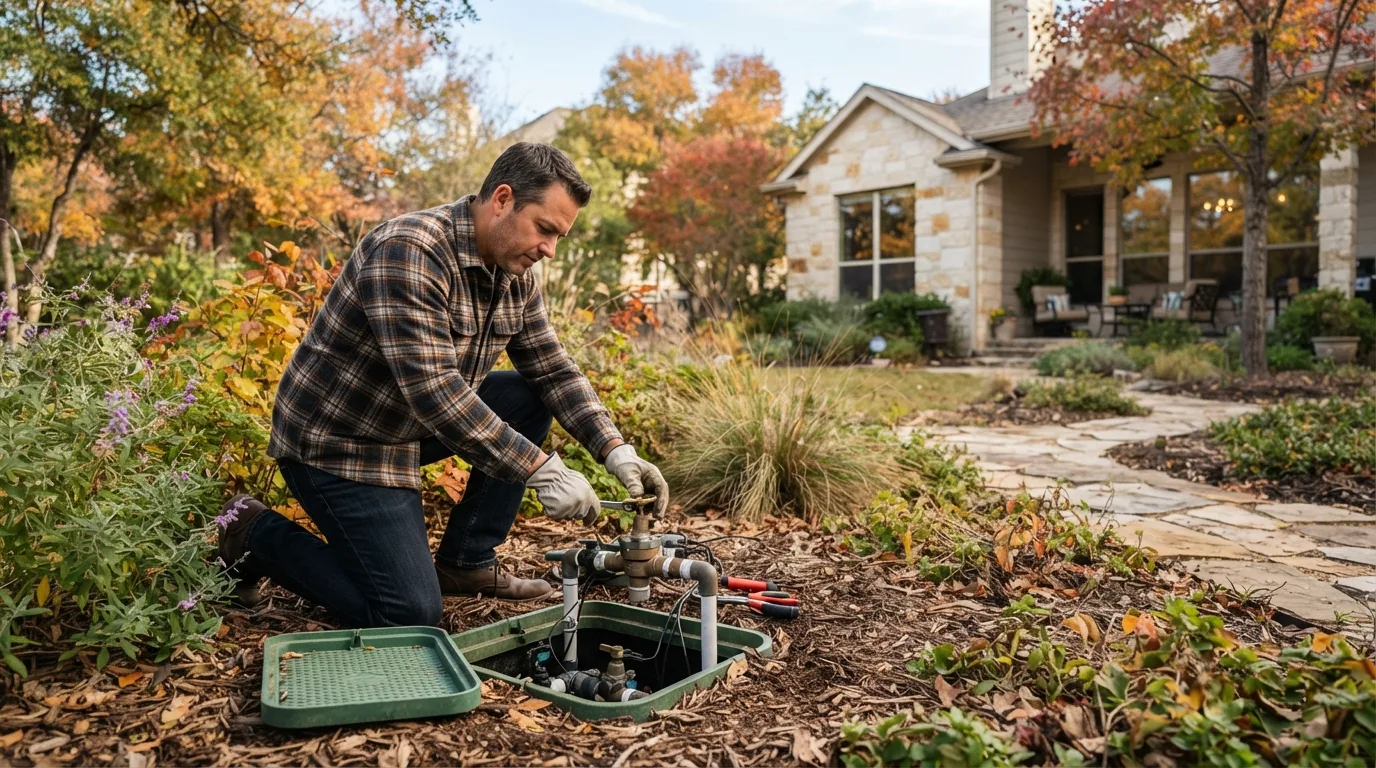
- Pressure vacuum breaker (PVB): a brass device that sits above ground, usually 12 inches or more above the highest sprinkler head. Very common on residential systems. Exposed to cold air, so it needs insulation.
- Double check valve assembly: often installed below ground in a valve box. Less exposed, but the box lid should be in place and intact.
- Reduced pressure zone assembly (RPZ): above ground, larger, and found on some residential and many commercial properties. Needs insulation, and has its own winter steps.
Knowing which one you have tells you how much freeze protection it needs. It also matters if you live in a city with backflow testing rules. Austin does not require annual testing for standard residential systems, but Round Rock requires testing every seven years for standard devices and every year for high-hazard devices.
Count Your Zones and Walk Them
Run each zone manually from the controller and walk it while it runs. Note which areas each zone covers and look for heads that do not pop up, spray onto pavement, or leak. Do this once in the fall, and you will know what normal looks like when something changes.
Step 2: What We Commonly Find on New-Construction Systems
A new home does not mean a sprinkler system that is ready for winter. These are the issues we see most often on systems in their first year.
The Controller Is Still on the Sod Schedule
New sod needs frequent watering to root in, so new-build systems are often programmed to water often, sometimes every day. Many homeowners never change that schedule. By fall, an established lawn is getting far more water than it can use, which leads to runoff, soggy spots, and fungus such as brown patch in St. Augustine. Once the sod has rooted, the schedule should be reset for an established lawn, then reduced again for winter.
Heads Are Sunk or Covered
Sod settles in the first year, and new landscaping adds mulch, edging, and shrubs. Heads that were level at installation end up below grade, buried in mulch, or blocked by new plants. Raising and leveling heads and adjusting spray patterns is a fast fix, and it is easiest to diagnose before the lawn goes dormant and turns brown.
The Backflow Preventer Has No Insulation
Builders rarely insulate the backflow device. On new homes, the pressure vacuum breaker often sits bare next to the house or near the meter. A cracked backflow after a hard freeze is one of the most common winter repair calls we get, and insulation installed in the fall prevents most of that damage.
There Is No Rain/Freeze Sensor, or It Was Never Connected
Some systems were installed without a sensor. Others have one mounted on the house that was never wired to the controller, or was set to bypass during sod establishment. A working rain/freeze sensor stops the system during rain and when temperatures drop near freezing, which keeps sidewalks and driveways from icing over.
The Warranty Clock Is Running
Check the warranty dates on your controller label. If you have found leaks, dead zones, or heads that never worked right, document them and report them to your builder or installer before the warranty ends.
Step 3: Set a Winter Watering Schedule
How Often to Water Your Lawn in Winter
Once the lawn is dormant, plan on watering about every other week during dry stretches, and skip it when we have had rain. Keep watering deep and infrequent, and use cycle and soak (splitting a zone's run time into two shorter runs) so water soaks into Central Texas clay instead of running off.
Your watering day still depends on your city and address. Austin Water, Round Rock, Cedar Park, Pflugerville, Leander, Hutto, and Taylor each set their own rules, and they change with water use stages. Check your utility's current schedule before you program the controller.
How to Program Your Sprinkler System for Winter
Most controllers from Rain Bird, Hunter, and Rachio give you two ways to cut back for winter:
Change each zone's run time and the watering days directly.
Use the seasonal adjust feature, which lowers every zone's run time by a percentage. This is the faster option, since you change one setting instead of every zone, and you can raise it again in spring.
Leave the controller in the "run" or "auto" position. Setting it to "off" for the season stops the system from running at all, which is the problem described above.
If You Have a Wi-Fi Smart Controller
Smart controllers adjust run times to local weather and let you control the system from your phone. That is useful in winter, especially if you travel for the holidays. Confirm the controller is still connected to your home's Wi-Fi. If the router was replaced or the signal is weak near the garage, the controller may have fallen back to a fixed schedule without telling you.
Step 4: Know What to Do When a Hard Freeze Is Forecast
When Austin Gets Its First Freeze
The average first freeze at Camp Mabry in central Austin is around December 1. Suburbs outside the urban core, including Leander, Cedar Park, Hutto, and Taylor, often see one earlier. Early freezes happen, and Central Texas has also seen extended freeze events, including Winter Storm Uri in February 2021 and the ice storm in February 2023. Aim to have your freeze prep done by mid-November.
Before a Hard Freeze
Confirm the backflow preventer is insulated and the cover is secure.
Check that the rain/freeze sensor is working, or pause watering from the controller.
If the forecast calls for an extreme or multi-day freeze, close the irrigation shut-off valve.
When shutting the water off, use the irrigation shut-off valve upstream of the backflow preventer when possible. Closing only the valves on the backflow device can trap water inside it with no room to expand.
After a Freeze
Once temperatures are back above freezing, open the shut-off valve slowly and run each zone. Look for water bubbling up from the ground, a leaking backflow device, or heads that do not pop up. If you see water spraying from the backflow preventer, shut the water off again and call a technician.
Leaving Town for the Holidays?
A one- or two-week trip in winter does not require shutting the system down. Before you leave, confirm the backflow is insulated and the freeze sensor works. If a hard freeze is forecast while you are gone, close the irrigation shut-off valve before you leave, since a burst pipe can run for days before anyone notices. A Wi-Fi controller lets you pause watering remotely if the forecast changes.
First-Winter in Austin Sprinkler Checklist
- Read the label on your controller for installer and warranty information.
- Ask your builder or seller for the as-built drawing and maintenance checklist.
- Find your irrigation shut-off valve and test that it turns.
- Identify your backflow preventer type and insulate it if it is above ground.
- Walk every zone and note leaks, sunken heads, and coverage problems.
- Reset a new-build controller from the sod schedule to an established-lawn schedule.
- Lower run times for winter, or use seasonal adjust.
- Confirm your rain/freeze sensor is installed, connected, and working.
- Keep the controller in run or auto mode through the winter.
- Schedule a Winter System Service before mid-November.
Winter System Service for New Homeowners in Austin and Surrounding Areas
If this is your first winter with a sprinkler system, a Winter Sprinkler System Service is the simplest way to know it is ready. Our technicians will:
- Check the backflow device for proper protection and insulate it if it sits above ground.
- Check the system for freeze-vulnerable points.
- Inspect and adjust sprinkler heads in preparation for winter.
- Check for broken heads, broken pipes, and visible leaks.
- Confirm valves are operating properly.
- Program the controller for the winter season, upon request.
- Show you where your shut-off valve and backflow preventer are.
- Provide an estimate for any additional repairs needed.
Winter is also a good time to add or move a few sprinkler heads to fix dry corners or overspray, or to add upgrades, since our schedule opens up after the summer season.
Smart Earth Sprinklers serves homeowners in Austin, Cedar Park, Pflugerville, Round Rock, Leander, Hutto, and Taylor. We have certified backflow testers on staff for cities that require testing. Call (512) 694-1147 to schedule your Winter Sprinkler System Service.
Frequently Asked Questions
Do I need to winterize my sprinkler system in Texas?
Not the way northern systems are winterized. Central Texas systems are not blown out or drained. Instead, they need the backflow preventer insulated, freeze-vulnerable points checked, and a reduced winter watering schedule set. The system should stay on through the winter.
Where is my sprinkler system shut-off valve?
In most Austin-area homes, it is in a small valve box near the water meter, just upstream of the backflow preventer, or built into the backflow preventer itself. Most are quarter-turn ball valves. If there is no separate irrigation shut-off, the main shut-off for the house is the backup.
Should I turn off my sprinklers in the winter in Austin?
No. Reduce run times instead. Dormant grass still needs water about every other week during dry periods, and running the system keeps seals and valve diaphragms from drying out. Only shut off the water to the system during an extreme, prolonged freeze.
How often should I water my lawn in winter in Austin?
About every other week during dry stretches, and less after rain. Follow your city's assigned watering day and use cycle and soak to reduce runoff.
Should I run my sprinklers during a freeze?
No. Running sprinklers in freezing temperatures can ice over sidewalks and driveways. A working rain/freeze sensor stops the system automatically when temperatures drop near freezing.
What part of a sprinkler system freezes first in Austin?
The backflow preventer. It usually sits above ground and is exposed to cold air. Insulating it in the fall prevents most freeze damage.
How do I know what type of backflow preventer I have?
A brass device standing above ground near the house or meter is usually a pressure vacuum breaker. A larger above-ground assembly with a relief port on the bottom is usually a reduced pressure zone assembly (RPZ). If you do not see one above ground, it may be a double check valve in a buried valve box.
Does my new home's sprinkler system have a warranty?
Check the label on your controller. Texas rules require the installing irrigator to list their name, license number, phone number, and warranty dates on it. Report any problems to your builder or installer before the warranty period ends.