In Part 1 of this article, we detailed turf rotors, spray heads, and drip irrigation. Part 2 is an examination of micro irrigation systems.
Micro irrigation is a low-flow-rate, low-pressure type of irrigation, often referred to as low-flow irrigation. The standard used by the International Code Council (ICC) and the American Society of Agricultural and Biological Engineers (ASABE) to define micro irrigation is that water must discharge at flow rates less than 30 gallons per hour (gph), operated at 30 pounds per square inch (psi). Basically, micro irrigation is designed to apply small amounts of water slowly near or at the root zones of plants.
Micro irrigation makes use of micro sprays, soakers, micro bubblers, and drip or subsurface mechanisms. The benefits of micro irrigation include:
- Minimizes water loss from wind, evaporation and runoff.
- It’s adaptable and changeable. Can be expanded for additional plants, and repositioned or removed. Drip emitters can be exchanged or removed.
- Irrigates difficult landscapes, such as narrow, curved or sloped areas.
- Preserves fertilizers and nutrients in the soil.
- Minimizes weed growth and reduces watering frequency due to targeted watering.
- Meets variable water needs of new, maturing, and established plants.
- Efficiently irrigates gardens with dense plants.
- Matches more precisely watering application rate to the soil’s infiltration rate.
- Minimizes fungus and insect activity, as water stays near the root system, resulting in decreased need for herbicides and pesticides.
- Is often exempt from watering restrictions because of efficiency (uses 20 to 50 percent less water than conventional spray sprinkler systems).
Micro Irrigation Emission Devices
Emitters or Drippers
Emitters, or drippers, are the components installed on, or in, polyethylene tubing to deliver water to the plant from the mainline tubing. Essentially, they’re small plastic nozzles that reduce and regulate the amount of water discharged. Some are attached to the tubing using barbs or threads, and some are actually built into the tubing or pipe.
In-line drip tubing, where the drip emitters have been pre-installed into the tubing at evenly spaced intervals, can be used for vegetable and flower gardens, raised beds, planter boxes, container gardens, groups of cacti, ground covers, large bushes, shrubs, hedges, and trees. The tubing commonly comes in 1/4 and 1/2 inch sizes, with the emitters spaced 12 to 36 inches apart. The emitters are designed to deliver water rates of 1/2, 1, or 2 gph, to suit different soil types. Because of its flexibility, drip tubing can irrigate narrow or irregularly shaped areas, as well as straight rows. It can be covered with a few inches of mulch for UV protection, and to prevent water evaporation.
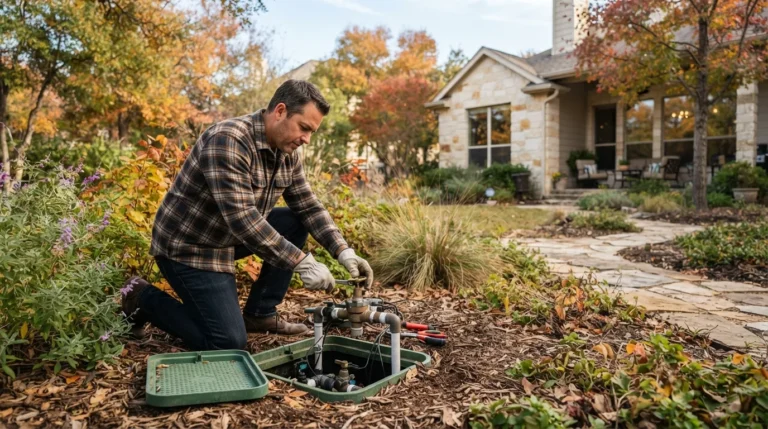
User-installed, or punch-in emitters, provide more versatility, and allow customized spacing on the tubing to accommodate a variety of plant sizes or irregular plant spacing. They’re available in the usual flow rates of 1/2, 1, and 2 gph. A specialized punch tool is usually used to punch holes in the irrigation tubing. The emitter is then pressed into the hole and held there by its barbed end. Some emitters have self-piercing barbs that make their own hole. You can even install emitters manually on pre-installed tubing.
Punch-in drippers can be used in a number of ways:
- Install them into the main tube to water plants right beside it.
- Attach delivery tubes (spaghetti tubing) to the emitters on the main tube, run the tubing to pots, and mount the tubing on a stake to drip into the potted plants.
- Install connectors into the main tube, run spaghetti tubing from the connectors to pots, attach emitters to the ends of the spaghetti tubing, and mount them on stakes to reach and drip into the pots.
- Install connectors into the main tube, attach and run spaghetti tubing with an emitter attached to the end out to ground-level plants that aren’t close to the main tube.
Micro bubblers
Micro bubblers on a spike can be attached to irrigation tubing using connectors and spaghetti tubes. They’re ideal for larger plants, such as roses and shrubs, containers, flower beds, and for filling basins around newly planted trees or shrubs.
Micro Spray
Micro spray irrigation is a cross between surface spray and drip irrigation. The micro sprays are connected to the irrigation tubing through a connector and spaghetti tubing and attached to risers that are either fixed or pop-up. Micro spray irrigation is well suited for irrigating ground covers, large flowerbeds, or plants in gardens with higher water needs than others.
Soaker Hoses
Soaker hoses are often referred to as porous pipes, drip hoses, or laser tubing. A soaker hose is a porous tube that looks like a garden hose, and seeps water along its entire length. Most are made from some combination of rubber and polyethylene plastic, but now some BPA-free, polyurethane models are available. You can easily wind them through your planting beds or move them from place to place. They’re best used in small gardens and raised beds on level ground where the plants are close together. Soaker hoses don’t allow for pressure regulation, and both elevated areas and areas near the end of the hose will discharge less water. They can be covered with 2 to 3 inches of mulch to protect them from sunlight and conserve water.
A licensed irrigator will know how to design, plan, and install any of the irrigation types and is uniquely qualified to advise you on the irrigation types you should use for your landscape.
For the best in irrigation design, installation, maintenance and repair, call Smart Earth Sprinklers at (512) 694-1147.